
BisMillah

gateway to Professional saefty Certification

Work Permit Receiver (WPR) Trainng

DO IT with APPROVED CENTER

Boost Your Safety Career

othm level 3 certificate

Duration

1-2 days

Mode of Study

Online

Locations

Lahore

Awarding Body

Abacus International

What Is Work Permit Receiver (WPR) Training?

The Work Permit Receiver (WPR) Course is a specialized occupational health and safety training program designed to equip professionals with the knowledge and practical competence required to receive, understand, implement, and monitor work permits in high risk work environments.

A Work Permit Receiver is the authorized person at the job site who accepts the Permit to Work (PTW) from the permit issuer, ensures all safety precautions and controls are in place, supervises the execution of hazardous work activities, and confirms that the worksite is returned to a safe condition upon job completion.

This course is aligned with international safety standards including:

  • OSHA (Occupational Safety and Health Administration)
  • NEBOSH Guidelines
  • ISO 45001:2018 — Occupational Health & Safety Management System
  • ADNOC/ARAMCO/SABIC Permit to Work Standards
  • OGP (IOGP) Report 423 — HSE Management Guidelines
  • Pakistan PEPA (Pakistan Environmental Protection Act) Compliance
  • Factories Act 1934 (Pakistan) Safety Requirements

fee & facilities For Work Permit Receiver (WPR)

Online Session

  • Certified Experienced Tutors
  • Latest Study Material
  • 02 Classes
  • 24/7 WhatsApp Tutor Support
  • Classes via Skype or ZOOM

Syllabus for Work Permit Receiver course in Lahore

Course Outline

  • Definition and purpose of PTW systems
  • History and evolution of work permit systems globally
  • Why PTW systems exist, accident case studies
  • Legal and regulatory framework (Pakistan, GCC, International)
  • Types of PTW systems: Paper-based vs Electronic (e-PTW)
  • Permit Issuer — Authority and accountability
  • Permit Receiver — Duties before, during, and after work
  • Area Authority / Site Authority — Oversight and approval
  • Performing Authority — The work crew’s responsibilities
  • HSE Officer’s role in the permit process
  • RACI Matrix for PTW roles
Permit TypeWhen RequiredKey Hazards
Hot Work PermitWelding, cutting, grinding, brazingFire, explosion, burns
Cold Work PermitMechanical maintenance, painting, scaffoldingFalls, struck-by, crush
Confined Space Entry PermitTanks, vessels, manholes, silosOxygen deficiency, toxic gases, engulfment
Electrical Work PermitLive/dead electrical work, isolationElectrocution, arc flash
Excavation PermitDigging, trenchingCave-in, utility strikes
Working at Height PermitAbove 1.8m / 6 feetFalls, dropped objects
Radiography PermitNDT / X-ray testingRadiation exposure
Critical Lift PermitHeavy crane operationsLoad drop, crane collapse
Simultaneous Operations (SIMOPS) PermitMultiple activities in same areaInteraction hazards
Line/Equipment Break PermitBreaking into piping, vesselsChemical release, pressure release
  1. Permit Request — Who initiates and why
  2. Hazard Identification & Risk Assessment — JSA/JHA integration
  3. Permit Preparation — Filling the permit form correctly
  4. Permit Approval & Issue — Authority sign-off
  5. Permit Receipt — Receiver’s verification checklist
  6. Work Execution Under Permit — Monitoring & compliance
  7. Permit Suspension — When and how to suspend
  8. Permit Extension / Revalidation — Procedures
  9. Permit Closure & De-isolation — Safe handback
  10. Permit Audit & Record Keeping — Documentation requirements

Before accepting ANY permit, the receiver MUST verify:

  • Correct work location identified
  • Scope of work clearly defined
  • All hazards identified and controls in place
  • Isolations completed and verified (LOTO)
  • Gas testing completed (LEL, O2, H2S, CO readings)
  • Required PPE available and inspected
  • Emergency procedures understood
  • Communication channels established
  • All signatures obtained
  • Permit validity time confirmed
  • Adjacent/simultaneous operations checked
  • Weather conditions assessed
  • HIRA methodology
  • Toolbox Talk requirements before starting work
  • Dynamic risk assessment during work
  • Bowtie Analysis for critical tasks
  • Hierarchy of Controls application
  • Job Safety Analysis (JSA) / Job Hazard Analysis (JHA)
  • Mechanical isolation
  • Electrical isolation
  • Process/chemical isolation
  • Pneumatic and hydraulic isolation
  • Multi-lock/multi-tag systems
  • Verification and try-out procedures
  • Isolation certificates and cross-referencing with permits
  • Receiver’s duty to VERIFY isolation — not assume
  • Types of gas detectors (4-gas monitors)
  • Acceptable atmospheric readings:
    • Oxygen: 19.5% – 23.5%
    • LEL: Below 10%
    • H2S: Below 10 ppm
    • CO: Below 35 ppm
  • Continuous monitoring requirements
  • Calibration and bump testing
  • Who can perform gas tests
  • Receiver’s responsibility to check gas test validity
  • Emergency scenarios during live permits
  • Fire response during hot work
  • Rescue procedures for confined space
  • Medical emergency protocols
  • Evacuation routes and muster points
  • Emergency communication systems
  • Incident notification chain
  • When to STOP WORK — Stop Work Authority (SWA)
  • Toolbox talks / Pre-job briefings
  • Shift handover during active permits
  • Multi-discipline coordination
  • Cross-permit awareness (SIMOPS)
  • Radio communication protocols
  • Digital permit management systems

Case Study 1: Piper Alpha Disaster (1988)

  • 167 deaths caused by PTW system failure
  • Permits not properly handed over during shift change
  • Lesson: Receiver must NEVER assume previous shift completed work

Case Study 2: Texas City Refinery Explosion (2005)

  • 15 deaths, 180 injuries
  • Inadequate isolation and permit violations
  • Lesson: Receivers must verify isolation independently

Case Study 3: Confined Space Fatality — Karachi Industrial Zone (2022)

  • Worker entered without valid gas test
  • Permit receiver did not verify atmospheric readings
  • Lesson: Gas test validity is the receiver’s responsibility

Case Study 4: Hot Work Fire — ARAMCO Contractor Incident

  • Welding near hydrocarbon residue
  • Fire watch not positioned correctly
  • Lesson: Receiver must ensure fire watch is in place BEFORE work starts
  • Written assessment (multiple choice + scenario-based)
  • Practical assessment (permit form completion exercise)
  • Minimum passing score: 70%
  • Certificate issuance process
  • Continuing Professional Development (CPD) points
  • Refresher training requirements (annual recommended)

Who Should Attend WPR training?

The WPR course is essential for:

Professional RoleWhy They Need This Course
Site Supervisors & ForemenDirectly receive permits and supervise work crews
Maintenance TechniciansPerform hot work, cold work, electrical tasks under permits
HSE Officers & Safety EngineersAudit and oversee PTW compliance
Construction Site EngineersManage multi-permit environments
Plant OperatorsIssue & receive permits in process plants
Scaffolders & RiggersWork at height under permit conditions
Electricians & Instrument TechniciansElectrical isolation and LOTO execution
Welders & FittersHot work permit receivers
Contractors & Sub-contractorsMandatory for site access on major projects
Fresh Graduates in Engineering/SafetyCareer-launching certification
Oil & Gas ProfessionalsARAMCO, ADNOC, SABIC, PDO project requirements
Factory & Warehouse ManagersIndustrial compliance in Pakistan

Request a Call Back

One of our learning adviser will call you soon.

Industries That Require WPR Certification:

  • 🛢️ Oil & Gas (Upstream, Midstream, Downstream)
  • 🏗️ Construction & Infrastructure
  • ⚡ Power Generation & Distribution
  • 🏭 Manufacturing & Processing
  • ⚗️ Chemical & Petrochemical
  • 🚢 Marine & Shipyard
  • ⛏️ Mining & Minerals
  • 🏥 Pharmaceuticals
  • 🍔 Food & Beverage Processing
  • 🛠️ Facilities Management & Maintenance

Duration and delivery

Work Permit receiver course in Lahore, Islamabad & Karachi, Pakistan is designed to be delivered in 1-2 days approximately for full-time study, but it is also flexible in its delivery in order to accommodate part-time and distance and blended learning.

The qualification is delivered face-to-face, through lectures, tutorials, seminars, distance, online by approved centres only.

Certification & Accreditation

Upon successful completion, participants receive:

✅ Work Permit Receiver (WPR) Certificate
✅ Certificate valid for client audits and project site access
✅ Aligned with international PTW standards
✅ CPD points eligible
✅ Digital and hard copy certificate provided
✅ Verification available online

Accepted by:

  • ARAMCO, SABIC, ADNOC, PDO, QatarEnergy contractors
  • Pakistani industrial clients (FFC, Engro, PARCO, OGDCL, PSO)
  • International EPC contractors
  • NEBOSH & IOSH CPD frameworks

Assessment Method – Work Permit Receiver Course in Lahore

The assessment process of our Work Permit Receiver Course in Lahore is designed to ensure participants are fully competent to manage Permit to Work (PTW) responsibilities safely and professionally in industrial environments.

Our evaluation method combines theoretical understanding with practical application to meet industry standards in Pakistan.

1️⃣ Written Knowledge Test

Participants will complete a structured written assessment consisting of multiple-choice and short-answer questions covering:

  • Fundamentals of the Permit to Work (PTW) system

  • Roles and responsibilities of a Work Permit Receiver

  • Types of permits (Hot Work, Confined Space, Electrical, Cold Work)

  • Hazard identification and risk control measures

  • Legal and workplace safety compliance requirements

This ensures learners understand the core principles of work permit systems used in construction, oil & gas, and industrial sectors in Lahore and across Pakistan.

2️⃣ Practical Scenario-Based Evaluation

To ensure real-world competency, participants will be assessed through practical exercises such as:

  • Reviewing and verifying a work permit before job commencement

  • Conducting pre-work site inspection

  • Identifying unsafe conditions and recommending control measures

  • Delivering a toolbox talk to the work team

  • Ensuring compliance with permit conditions during work execution

This practical assessment reflects actual job responsibilities of a Work Permit Receiver.

3️⃣ Continuous Performance Evaluation

Throughout the training program, instructors will continuously evaluate:

  • Active participation in discussions

  • Understanding of PTW procedures

  • Ability to apply safety controls in simulated workplace scenarios

Certification Requirements

To successfully complete the Work Permit Receiver Course in Lahore, participants must:

  • Achieve the minimum passing score in the written assessment

  • Demonstrate competency in practical exercises

  • Attend the full duration of the training session

Upon successful completion, participants will receive a recognized Work Permit Receiver (WPR) certificate.

HOW WORK PERMIT RECEIVER TRAINING IS BEST FOR YOU?

Contact Our Learning Advisor

Get answers to your Queries Right Away

Why Choose Abacus For Work Permit Receiver Training in Pakistan?

Approved Institute

Certified Tutors

Latest Study Material

Dedicated Team

8+ Years of Experience

Abacus International Training & Consultancy is best institute offer Work permit receiver course in Pakisan.  Abacus International as a leading Training and Consultancy Company on boards an immense team of internationally certified experienced Trainers and Consultants. Our expert team makes customize solutions for specific business needs which also comply international standards.

Other Services We Offer:

We offer Internationally recognized Health and Safety training courses. These courses are validated and compliant by number of international health and safety boards and their certifications are renowned globally.

We provide in-house customized trainings rendering to client’s requirements. Any organization considering posing an in-house training for its team or 3rd party, we can deliver training as per required topic.

To make sure you gain full market access & your services comply with the requirements of your target market. Our customized industry specific and ISO standard consultancy enables the businesses to achieve their goals.

Our Clients

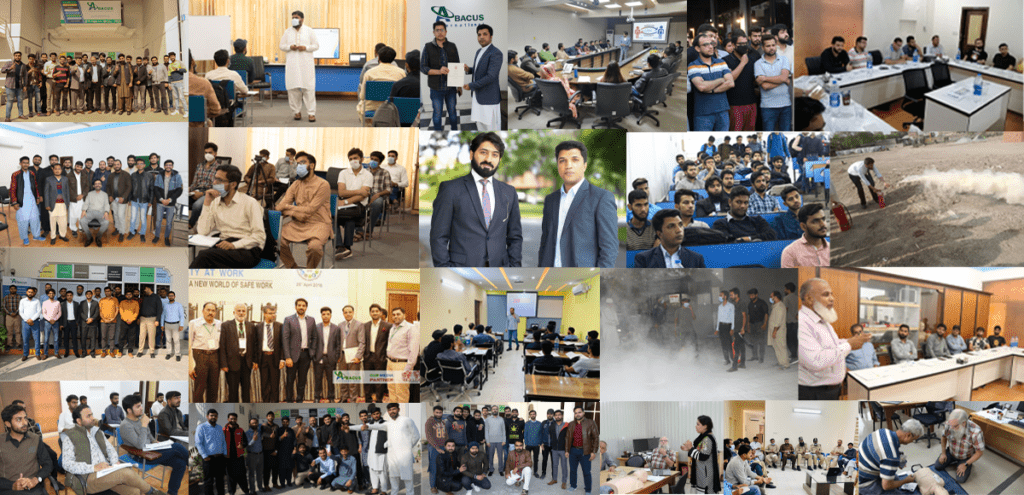
Work Permit Receiver Training Session Pictures

NEBOSH IGC Session Pictures

Frequently Asked Questions (FAQs)

The Permit Issuer is typically the Area Authority or Operations representative who authorizes the work and confirms the area is safe. The Permit Receiver is the person (usually a supervisor or foreman) who accepts the permit, ensures controls are implemented at the worksite, and is responsible for the work crew’s safety during the task.

Abacus International offer typically 1 to 2 days (8 to 16 contact hours),WPR course in Lahore, Isalmabad & karacchi, including theory, case studies, practical exercises, and assessment.

There are no formal prerequisites. However, a basic understanding of workplace safety or prior experience in industrial environments is beneficial.

Abacus International WPR certificate is recognized by major oil & gas companies, EPC contractors, and industrial clients in Pakistan, the Middle East (Saudi Arabia, UAE, Qatar, Oman, Bahrain, Kuwait), and other international markets.

Yes, Abacus International offer both classroom-based training in Lahore, Islamabad, and Karachi, as well as online/virtual instructor-led training for participants who cannot attend in person.

A Permit Receiver may handle Hot Work Permits, Cold Work Permits, Confined Space Entry Permits, Electrical Work Permits, Excavation Permits, Working at Height Permits, Radiography Permits, Critical Lift Permits, Line Break Permits, and SIMOPS Permits.

Customer Reviews

Related Courses

Level 2 Qualification (UK)

General Industry (USA)

Level 2 Award (UK)

Level 3 Award (UK)

Recent Posts